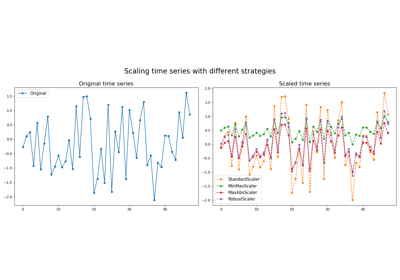
pyts.preprocessing.MinMaxScaler
-
class
pyts.preprocessing.MinMaxScaler(sample_range=(0, 1))[source]¶ Transforms samples by scaling each sample to a given range.
Parameters: - sample_range : tuple (min, max) (default = (0, 1))
Desired range of transformed data.
Examples
>>> from pyts.preprocessing import MinMaxScaler
>>> X = [[1, 5, 3, 2, 9, 6, 4, 7],
...      [1, -2, 3, 2, 2, 1, 0, 2]]
>>> scaler = MinMaxScaler()
>>> scaler.transform(X)
array([[0.   , 0.5  , 0.25 , 0.125, 1.   , 0.625, 0.375, 0.75 ],
       [0.6  , 0.   , 1.   , 0.8  , 0.8  , 0.6  , 0.4  , 0.8  ]])
Methods
__init__([sample_range])Initialize self. fit([X, y])Pass. fit_transform(X[, y])Fit to data, then transform it. get_metadata_routing()Get metadata routing of this object. get_params([deep])Get parameters for this estimator. set_output(*[, transform])Set output container. set_params(**params)Set the parameters of this estimator. transform(X)Scale samples of X according to sample_range. -
__init__(sample_range=(0, 1))[source]¶ Initialize self. See help(type(self)) for accurate signature.
-
fit_transform(X, y=None, **fit_params)¶ Fit to data, then transform it.
Fits transformer to X and y with optional parameters fit_params and returns a transformed version of X.
Parameters: - X : array-like of shape (n_samples, n_features)
Input samples.
- y : array-like of shape (n_samples,) or (n_samples, n_outputs), default=None
Target values (None for unsupervised transformations).
- **fit_params : dict
Additional fit parameters.
Returns: - X_new : ndarray array of shape (n_samples, n_features_new)
Transformed array.
-
get_metadata_routing()¶ Get metadata routing of this object.
Please check User Guide on how the routing mechanism works.
Returns: - routing : MetadataRequest
A
MetadataRequestencapsulating routing information.
-
get_params(deep=True)¶ Get parameters for this estimator.
Parameters: - deep : bool, default=True
If True, will return the parameters for this estimator and contained subobjects that are estimators.
Returns: - params : dict
Parameter names mapped to their values.
-
set_output(*, transform=None)¶ Set output container.
See Introducing the set_output API for an example on how to use the API.
Parameters: - transform : {“default”, “pandas”, “polars”}, default=None
Configure output of transform and fit_transform.
- “default”: Default output format of a transformer
- “pandas”: DataFrame output
- “polars”: Polars output
- None: Transform configuration is unchanged
New in version 1.4: “polars” option was added.
Returns: - self : estimator instance
Estimator instance.
-
set_params(**params)¶ Set the parameters of this estimator.
The method works on simple estimators as well as on nested objects (such as
Pipeline). The latter have parameters of the form<component>__<parameter>so that it’s possible to update each component of a nested object.Parameters: - **params : dict
Estimator parameters.
Returns: - self : estimator instance
Estimator instance.