ROCKET#
- class pyts.transformation.ROCKET(n_kernels: int = 10000, kernel_sizes: ArrayLike = (7, 9, 11), random_state: int | RandomState | None = None)[source]#
RandOm Convolutional KErnel Transformation.
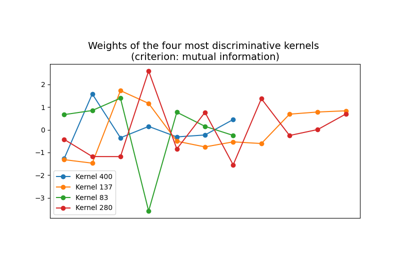
This algorithm randomly generates a great variety of convolutional kernels and extracts two features for each convolution: the maximum and the proportion of positive values.
- Parameters:
- n_kernelsint (default = 10000)
Number of kernels.
- kernel_sizesarray-like (default = (7, 9, 11))
The possible sizes of the kernels.
- random_stateNone, int or RandomState instance (default = None)
The seed of the pseudo random number generator to use when shuffling the data. If int, random_state is the seed used by the random number generator. If RandomState instance, random_state is the random number generator. If None, the random number generator is the RandomState instance used by np.random.
- Attributes:
- weights_array, shape = (n_kernels, max(kernel_sizes))
Weights of the kernels. Zero padding values are added.
- length_array, shape = (n_kernels,)
Length of each kernel.
- bias_array, shape = (n_kernels,)
Bias of each kernel.
- dilation_array, shape = (n_kernels,)
Dilation of each kernel.
- padding_array, shape = (n_kernels,)
Padding of each kernel.
References
[1]A. Dempster, F. Petitjean and G. I. Webb, “ROCKET: Exceptionally fast and accurate time series classification using random convolutional kernels”. https://arxiv.org/abs/1910.13051.
Examples
>>> from pyts.transformation import ROCKET
>>> X = np.arange(100).reshape(5, 20)
>>> rocket = ROCKET(n_kernels=10)
>>> rocket.fit_transform(X).shape
(5, 20)
Methods
__init__([n_kernels, kernel_sizes, random_state])fit(X[, y])Fit the model according to the given training data.
fit_transform(X[, y])Fit to data, then transform it.
get_metadata_routing()Get metadata routing of this object.
get_params([deep])Get parameters for this estimator.
set_params(**params)Set the parameters of this estimator.
transform(X)Transform the provided data.
- __init__(n_kernels: int = 10000, kernel_sizes: ArrayLike = (7, 9, 11), random_state: int | RandomState | None = None) None[source]#