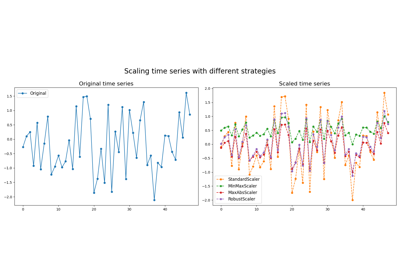
MinMaxScaler#
- class pyts.preprocessing.MinMaxScaler(sample_range: tuple[float, float] = (0, 1))[source]#
Transforms samples by scaling each sample to a given range.
- Parameters:
- sample_rangetuple (min, max) (default = (0, 1))
Desired range of transformed data.
Examples
>>> from pyts.preprocessing import MinMaxScaler
>>> X = [[1, 5, 3, 2, 9, 6, 4, 7],
...      [1, -2, 3, 2, 2, 1, 0, 2]]
>>> scaler = MinMaxScaler()
>>> scaler.transform(X)
array([[0.   , 0.5  , 0.25 , 0.125, 1.   , 0.625, 0.375, 0.75 ],
       [0.6  , 0.   , 1.   , 0.8  , 0.8  , 0.6  , 0.4  , 0.8  ]])
Methods
__init__([sample_range])fit([X, y])Pass.
fit_transform(X[, y])Fit to data, then transform it.
get_metadata_routing()Get metadata routing of this object.
get_params([deep])Get parameters for this estimator.
set_output(*[, transform])Set output container.
set_params(**params)Set the parameters of this estimator.
transform(X)Scale samples of X according to sample_range.