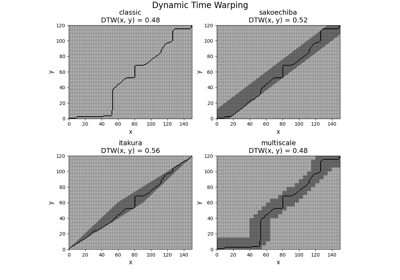
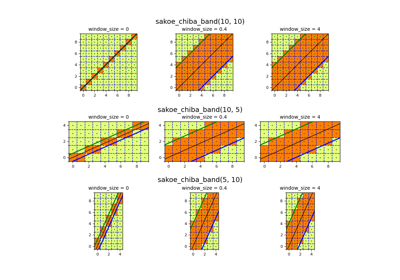
sakoe_chiba_band#
- pyts.metrics.sakoe_chiba_band(n_timestamps_1: int, n_timestamps_2: int | None = None, window_size: int | float = 0.1) NDArray[int64][source]#
Compute the Sakoe-Chiba band.
- Parameters:
- n_timestamps_1int
The size of the first time series.
- n_timestamps_2int (optional, default None)
The size of the second time series. If None, set to n_timestamps_1.
- window_sizefloat or int (default = 0.1)
The window size above and below the diagonale. If float, window_size must be between 0 and 1, and the actual window size will be computed as: ``ceil(window_size * max((n_timestamps_1, n_timestamps_2) - 1))`. If int, window_size must be the largest temporal shift allowed. Each cell whose distance with the diagonale is lower than or equal to ‘window_size’ becomes a valid cell for the path.
- Returns:
- regionarray, shape = (2, n_timestamps_1)
Constraint region. The first row consists of the starting indices (included) and the second row consists of the ending indices (excluded) of the valid rows for each column.
References
[1]H. Sakoe and S. Chiba, “Dynamic programming algorithm optimization for spoken word recognition”. IEEE Transactions on Acoustics, Speech, and Signal Processing, 26(1), 43-49 (1978).
Examples
>>> from pyts.metrics import sakoe_chiba_band
>>> print(sakoe_chiba_band(5, window_size=0.5))
[[0 0 0 1 2]
 [3 4 5 5 5]]