Note
Click here to download the full example code
Scalers
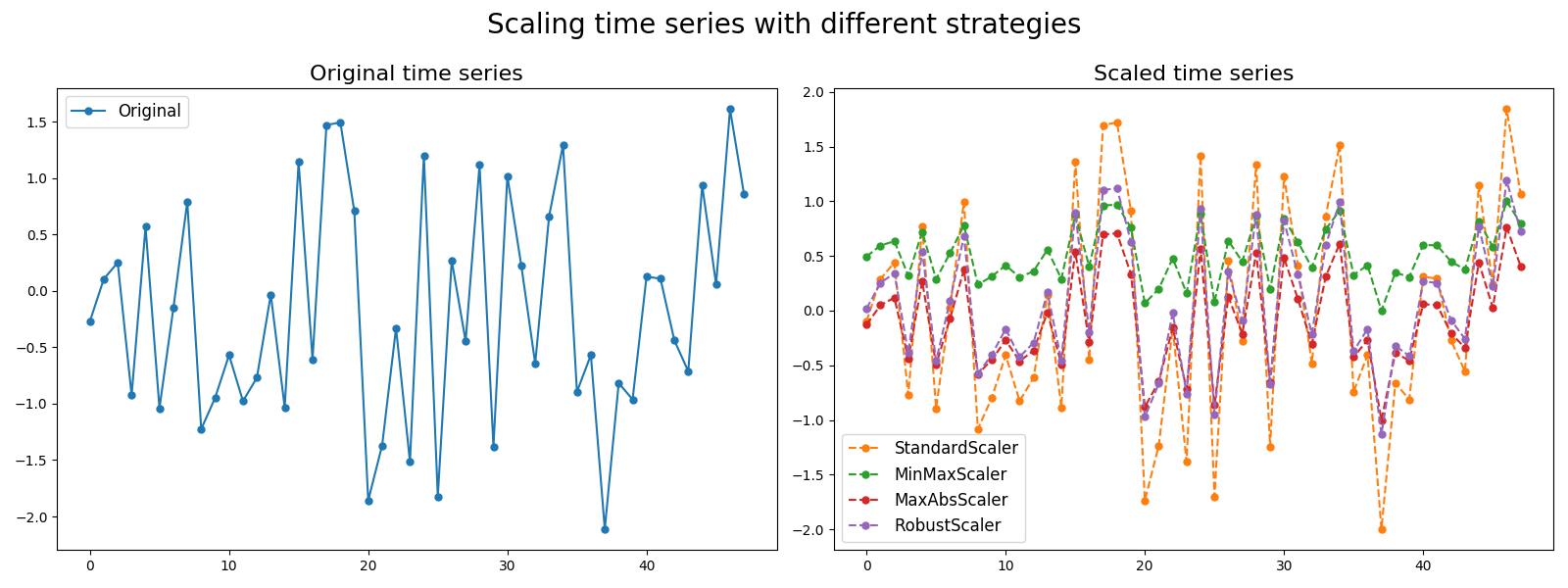
This example shows the different scaling algorithms available in
pyts.preprocessing.
import numpy as np
import matplotlib.pyplot as plt
from pyts.preprocessing import (StandardScaler, MinMaxScaler,
                                MaxAbsScaler, RobustScaler)

# Parameters
n_samples, n_timestamps = 100, 48
marker_size = 5

# Toy dataset
rng = np.random.RandomState(41)
X = rng.randn(n_samples, n_timestamps)

# Scale the data with different scaling algorithms
X_standard = StandardScaler().transform(X)
X_minmax = MinMaxScaler(sample_range=(0, 1)).transform(X)
X_maxabs = MaxAbsScaler().transform(X)
X_robust = RobustScaler(quantile_range=(25.0, 75.0)).transform(X)

# Show the results for the first time series
plt.figure(figsize=(16, 6))

ax1 = plt.subplot(121)
ax1.plot(X[0], 'o-', ms=marker_size, label='Original')
ax1.set_title('Original time series', fontsize=16)
ax1.legend(loc='best', fontsize=12)

ax2 = plt.subplot(122)
ax2.plot(X_standard[0], 'o--', ms=marker_size, color='C1',
         label='StandardScaler')
ax2.plot(X_minmax[0], 'o--', ms=marker_size, color='C2', label='MinMaxScaler')
ax2.plot(X_maxabs[0], 'o--', ms=marker_size, color='C3', label='MaxAbsScaler')
ax2.plot(X_robust[0], 'o--', ms=marker_size, color='C4', label='RobustScaler')
ax2.set_title('Scaled time series', fontsize=16)
ax2.legend(loc='best', fontsize=12)

plt.suptitle('Scaling time series with different strategies', fontsize=20)
plt.tight_layout()
plt.subplots_adjust(top=0.85)
plt.show()
Total running time of the script: ( 0 minutes 0.455 seconds)